

Ethiopian Doro Wat (Berbere Chicken Stew)
A richly spiced Ethiopian chicken stew made with berbere, slowly cooked onions, and hard-boiled eggs, Doro Wat is traditionally served with injera, a soft, fermented flatbread.
Doro Wat is a richly spiced Ethiopian chicken stew made with berbere, a traditional spice blend of dried chili peppers and warming spices that gives the dish its distinctive color, heat, and depth of flavor. Slowly cooked onions form the foundation of the sauce, while tender chicken and hard-boiled eggs make this a hearty and satisfying dish. It's traditionally served with injera, a soft, slightly tangy fermented flatbread made primarily from teff flour, which has a spongy texture and is used to scoop up the stew and soak up its flavorful sauce.
When I first moved to the Washington, DC area, I found myself immersed in Ethiopian culture. I lived in an Ethiopian neighborhood, made friends from Ethiopia and the surrounding region, and naturally, I was introduced to the food. One of the first dishes I fell in love with was Doro Wat. Chicken stew was familiar enough, but the depth of flavor and complexity of the spices were unlike anything I'd tasted before. Berbere, in particular, was a revelation. I've loved that spice blend ever since, and if you've followed my cooking, you've probably noticed it makes an appearance quite often!
For the second installment of my African Comfort Food series, I'm revisiting this dish and bringing it into my own kitchen. Traditional Doro Wat is often prepared with niter kibbeh, an Ethiopian spiced clarified butter that adds depth and aroma to the stew. For my home-cooked version, I'm using plain ghee and adding the berbere separately, along with garlic and ginger. I'm also using bone-in chicken thighs and drumsticks, which simmer in the concentrated onion and spice mixture before hard-boiled eggs are added toward the end.
Doro Wat is often served during celebrations and special occasions in Ethiopia, though it is also enjoyed beyond those gatherings. Like many traditional dishes, its preparation can vary between households and cooks. This is my interpretation, inspired by the flavors and food traditions I came to appreciate through my experiences with Ethiopian food.
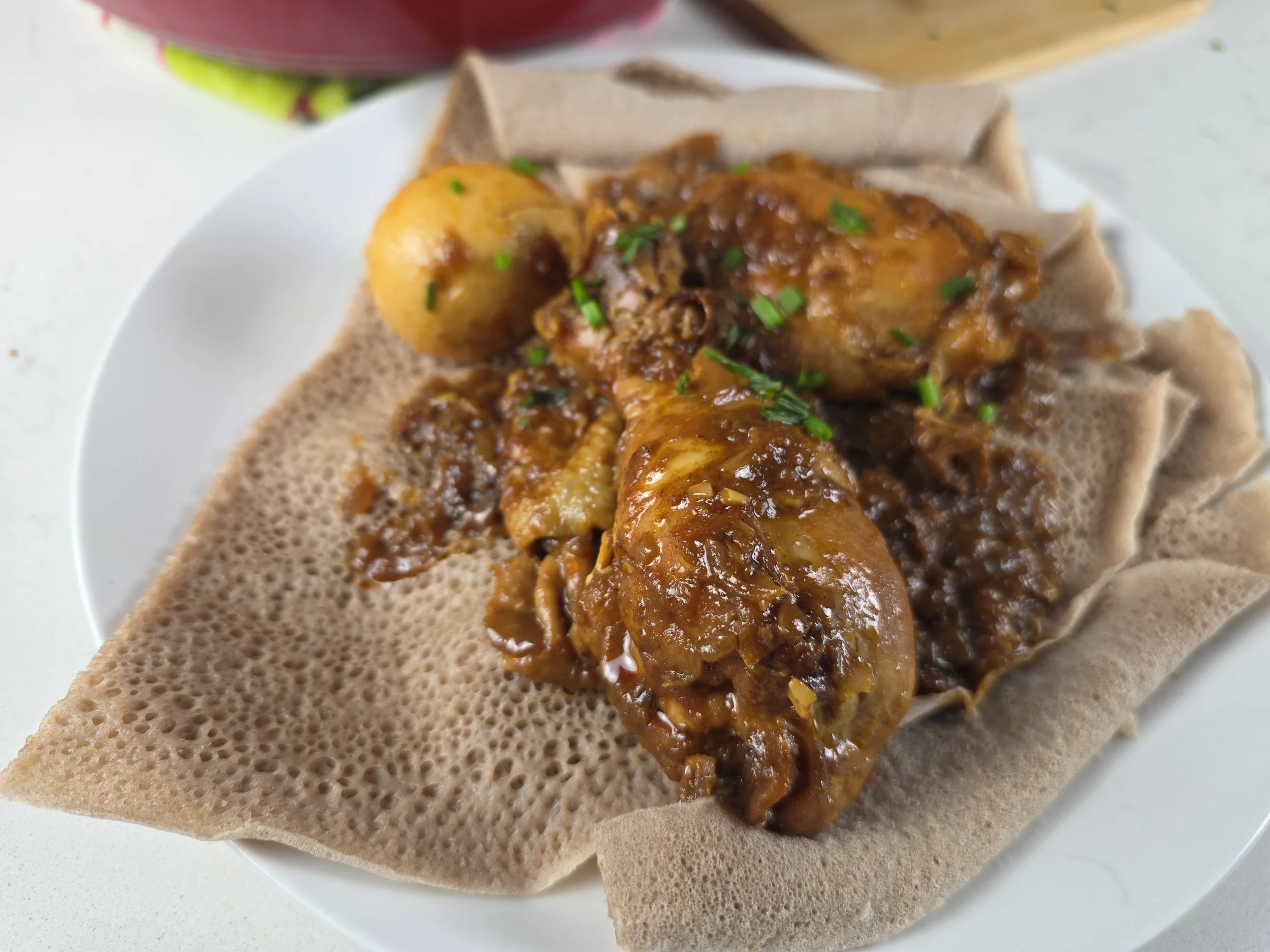

Ethiopian Doro Wat (Berbere Chicken Stew)
This Ethiopian-inspired Doro Wat features bone-in chicken simmered in a rich berbere and onion sauce with garlic, ginger, and ghee. Finished with hard-boiled eggs and served with injera, it's a deeply flavorful and comforting chicken stew.
Ingredients
- 4 bone-in chicken thighs
- 4 chicken drumsticks
- 2 tablespoons fresh lemon juice
- - 1 teaspoon salt
- - 1 teaspoon berbere seasoning
- **For the stew**
- - 6 yellow onions (1 large, 2 medium, and 3 small), finely diced
- - ⅓ cup ghee
- - 2 tablespoons berbere seasoning
- - 3 garlic cloves, minced
- - 1 tablespoon freshly grated ginger
- - 1 cup unsalted chicken stock or water, plus additional as needed
- - 6 large eggs
- - Additional salt, to taste
- - Fresh lemon juice, to finish if desired
- **For serving**
- - Injera
Instructions
- 1. **Marinate the chicken.** Place the chicken thighs and drumsticks in a large bowl. Add the lemon juice, salt, and 1 teaspoon of berbere seasoning. Toss to coat, cover, and refrigerate for 1½–2 hours.
- 2. **Cook the onions.** Add the finely diced onions to a large Dutch oven over medium-low heat without adding oil or butter. Cook uncovered for approximately 30–40 minutes, stirring frequently, until the onions have softened, reduced considerably, and developed a light golden color. If they begin sticking, add 1–2 tablespoons of water and scrape the bottom of the pot. Adjust the heat as necessary to prevent burning.
- 3. **Add the ghee and berbere.** Add the ghee to the cooked onions and stir until melted. Add the 2 tablespoons of berbere seasoning and cook gently for approximately 5 minutes, stirring frequently to prevent the spices from scorching.
- 4. **Add the aromatics.** Stir in the minced garlic and grated ginger. Cook for another 2–3 minutes until fragrant.
- 5. **Add the chicken.** Place the marinated chicken pieces directly into the onion and berbere mixture. Turn each piece to coat thoroughly in the sauce. Allow the chicken to cook in the mixture for approximately 5–7 minutes, turning occasionally.
- 6. **Add the liquid and simmer.** Pour in 1 cup of unsalted chicken stock or water. Stir gently to loosen the sauce from the bottom of the pot. Bring to a gentle simmer, then reduce the heat to low. Partially cover and cook for approximately 40–50 minutes, turning the chicken occasionally. Check the sauce periodically and add water in ¼-cup increments if it becomes too thick or begins sticking. Cook until the chicken is tender and reaches an internal temperature of at least 165°F.
- 7. **Prepare the eggs.** While the chicken cooks, place the eggs in a saucepan and cover with cold water. Bring to a boil, then cover, turn off the heat, and let stand for 12 minutes. Transfer the eggs to an ice bath, cool, and peel. Make 2–3 shallow slits lengthwise in each egg.
- 8. **Add the eggs.** Once the chicken is cooked through, gently nestle the peeled eggs into the stew. Spoon some of the sauce over the eggs and simmer uncovered on low for another 10–15 minutes, allowing them to absorb the flavors.
- 9. **Finish the stew.** Taste the sauce and adjust the salt as needed. Finish with a squeeze of fresh lemon juice if desired. The sauce should be thick, rich, and concentrated rather than watery.
- 10. **Serve.** Arrange the chicken and eggs with plenty of berbere sauce. Serve warm with injera.
Notes
- **Berbere seasoning:** Spice blends vary in heat and composition. Start with the recommended amount and adjust to your preference.
- **Ghee:** Ghee provides the cooking fat for this version. Traditional Ethiopian niter kibbeh is an infused clarified butter with its own distinctive preparation and flavor.
- **Onions:** Allow enough time for the onions to soften and reduce. They form the foundation of the sauce.
- **Cooking liquid:** Begin with 1 cup of stock or water and add more gradually as needed. The finished stew should have a thick consistency.
- **Injera:** Injera is traditionally served with Doro Wat. Keep it covered while warming to help prevent it from drying out.
- **Serving:** The chicken and eggs can be arranged over injera, with additional sauce spooned over the top.

Huku ne Dovi (Zimbabwean Peanut Chicken Stew)
Huku ne dovi, or Zimbabwean peanut butter chicken stew, is a hearty dish made with chicken simmered in a rich peanut butter sauce alongside tomatoes, vegetables, hot chilies, and sometimes bell peppers. The result is a beautiful balance of savory, nutty, and mildly spicy flavors. While often served as a thick stew alongside sadza, rice, or bread, it can also be prepared more like a soup, with the addition of leafy greens, vegetables, and tubers.
For those unfamiliar with the combination of chicken and peanut butter, it may sound unusual at first. Yet throughout much of Africa, groundnuts (peanuts) are a staple ingredient used to enrich sauces, soups, and stews. Similar pairings can also be found in parts of Southeast Asia, where peanuts are used to add richness and depth to savory dishes. In Zimbabwe, peanut butter gives huku ne dovi its distinctive flavor and velvety texture, creating a sauce that coats each piece of chicken beautifully. Beyond its flavor, peanut butter is also an important source of protein and is often used to enrich vegetable dishes or provide nourishment when meat is scarce or unavailable.
Growing up, huku ne dovi was not an everyday meal in my household, which made it feel even more special whenever it appeared on the table. It was the kind of dish that brought warmth and comfort, especially during the cooler months, and one that was best enjoyed with a generous serving of sadza, rice, or fresh bread to soak up every last bit of sauce.
One of the secrets to a great peanut butter chicken stew is finding the right balance between the richness of the peanut butter and the heat of the chilies. Neither should overpower the other. Instead, the gentle sweetness of the peanuts softens the spice, creating layers of flavor that develop as the stew simmers. This recipe is also highly adaptable. Some people prefer the chicken simmered until it becomes tender and nearly falls off the bone, allowing it to absorb the flavors of the sauce. Others enjoy chicken with a firmer texture and crisp, browned skin. If you prefer the latter, simply roast or brown the chicken separately and add it back to the stew just before serving.
The consistency of the sauce can be adjusted to suit your preference as well. A slightly thinner sauce is wonderful spooned over rice, while a thicker stew pairs beautifully with sadza or bread, allowing the sauce to cling to every bite. For the best flavor, use bone-in chicken pieces whenever possible and take the time to brown them before simmering. This simple step adds depth and richness to the finished dish. Allow the stew to cook gently rather than rushing the process, giving the flavors time to meld together and the sauce time to develop its signature richness.
Whether you're discovering Zimbabwean cuisine for the first time or recreating a familiar favorite, this is a dish that showcases the comforting simplicity and bold flavors that make home cooking easy, and memorable.
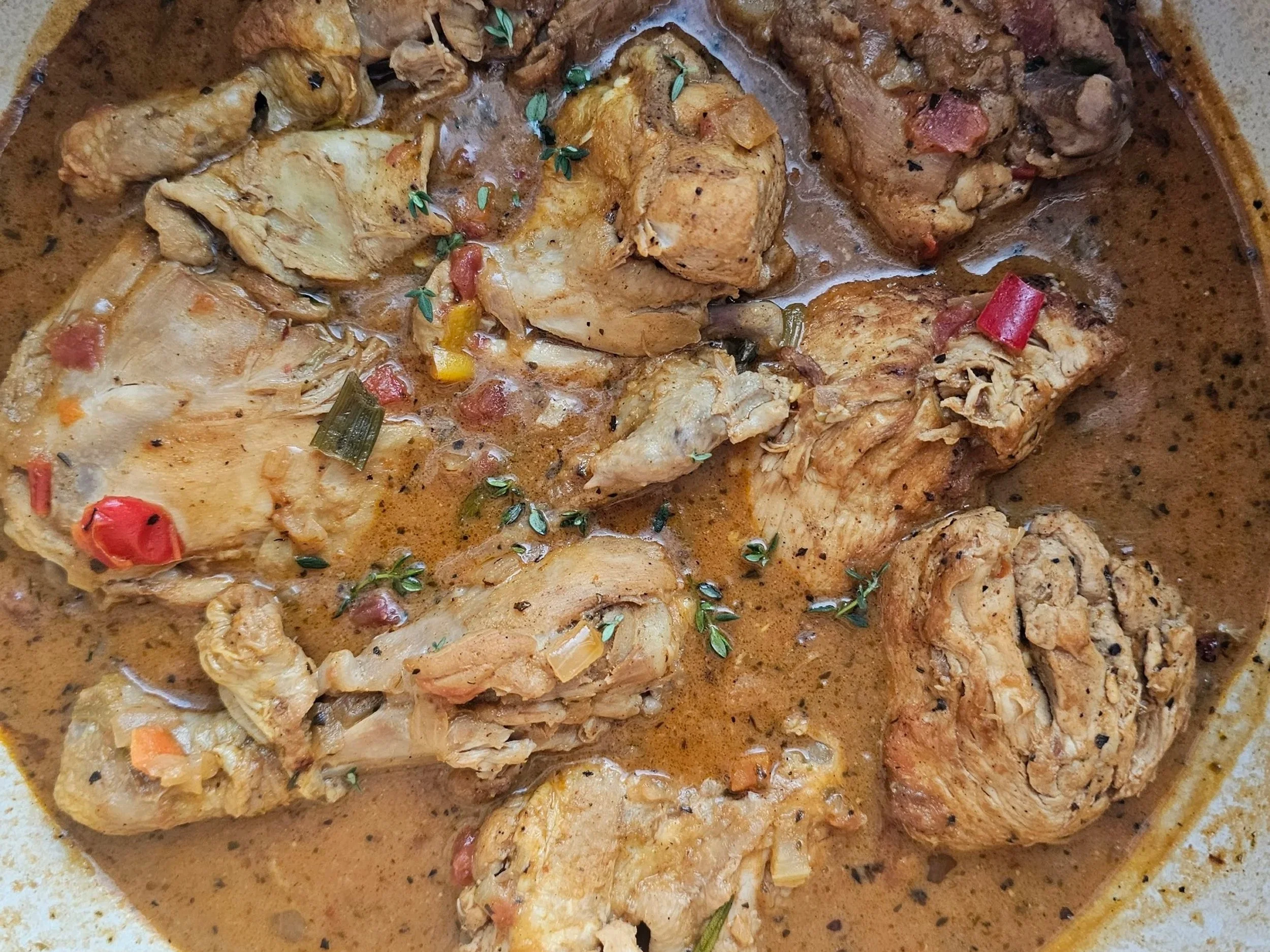

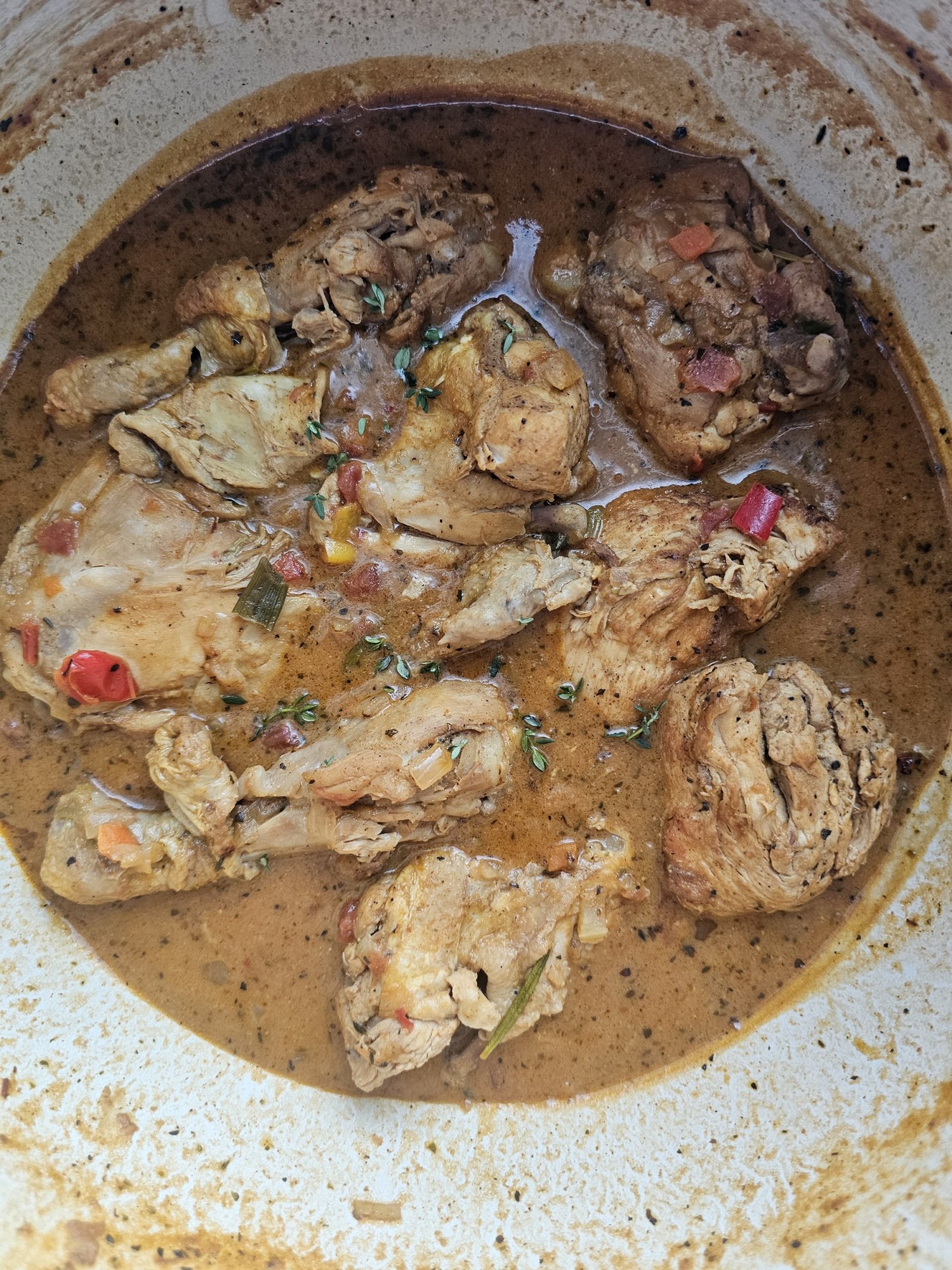
Huku ne Dovi (Spicy Zimbabwean Peanut Chicken Stew)
Zimbabwean Peanut Chicken Stew, or *huku ne dovi*, is a flavorful and comforting dish that combines tender chicken, smooth peanut butter, vibrant vegetables, spicy chilies, and fragrant spices.
Ingredients
- 1/4 cup olive oil
- 1 whole chicken, cleaned and cut into pieces
- 2 tablespoons chicken spice (I used Hind’s)
- 2 green onions
- 1 large hot chilli pepper
- 1/2 large yellow onion
- 1/2 cup mirepoix (chopped onion, carrots and celery)
- 1-2 tablespoons butter
- 1 tablespoon garlic powder
- 1 teaspoon black pepper
- 1 tablespoon paprika
- 1 tablespoon Royco Usavi Mix
- 3 chicken bouillon cubes
- 1/3 cup red wine
- 1 cup diced tomatoes
- 3 sweet bell peppers
- 1/3 cup peanut butter
- 2 tablespoons tomato paste
- 1 teaspoon ginger
- 1 teaspoon cumin
- 1 teaspoon coriander
- 1 teaspoon herb blend (I used basil and thyme)
- 3 cups water
- 3 bay leaves
- 2-3 tablespoons cornstarch or flour (optional)
Instructions
- Season the chicken with all-purpose chicken spice, then brown it in a Dutch oven or non-stick pan over medium to medium-high heat. Once browned, remove the chicken and set it aside.
- In the same pot, add the remaining oil and butter. Stir in the mirepoix, onions, bouillon cubes, garlic powder, black pepper, paprika, and Royco Usavi Mix. Sauté for 2-3 minutes until caramelized. Deglaze the pot with the wine, scraping up any browned bits to incorporate all the flavors.
- Next, add the tomatoes, peppers, chili peppers, cumin, ginger, and coriander. Cook for 1-2 minutes to allow the spices to bloom and the vegetables to soften.
- Return the chicken to the pot and pour in the water. Add more water if you prefer a thinner stew or soup-like consistency. Ensure as much of the chicken as possible is submerged to help it cook evenly. Simmer on low heat for 15-20 minutes.
- In a small bowl, mix the peanut butter with some of the hot stew liquid to thin it out. Stir in the tomato paste, then add the mixture to the pot, ensuring it is evenly distributed.
- Add the bay leaves and continue simmering for another 15-20 minutes.
- Optional: After 5-10 minutes, if you don’t want the chicken to fall off the bone, you can remove it and let the stew continue cooking separately to allow the flavors to come together.
- To thicken the sauce: Remove the chicken, then mix 2 tablespoons of cornstarch or flour with hot liquid from the pot to create a smooth slurry. Stir the slurry back into the pot, mixing well to activate the thickening. Continue cooking until the desired consistency is achieved.
- Season to taste, return the chicken to the pot, and serve hot with yellow rice or your preferred starch.
Nutrition Facts
Calories
438Fat (grams)
20.3 gSat. Fat (grams)
4.8 gCarbs (grams)
62.1 gFiber (grams)
18.5 gProtein (grams)
15.6 gI am not a certified nutritionist and any nutritional information on dontmissmyplate.com should only be used as a general guideline.