Chicken Yassa Inspired Loaded Fries
If you love loaded fries but you're ready for something beyond the usual cheese-and-bacon combination, these Chicken Yassa Inspired Loaded Fries bring a West African twist to one of America's favorite game-day foods without requiring you to cook chicken from scratch.
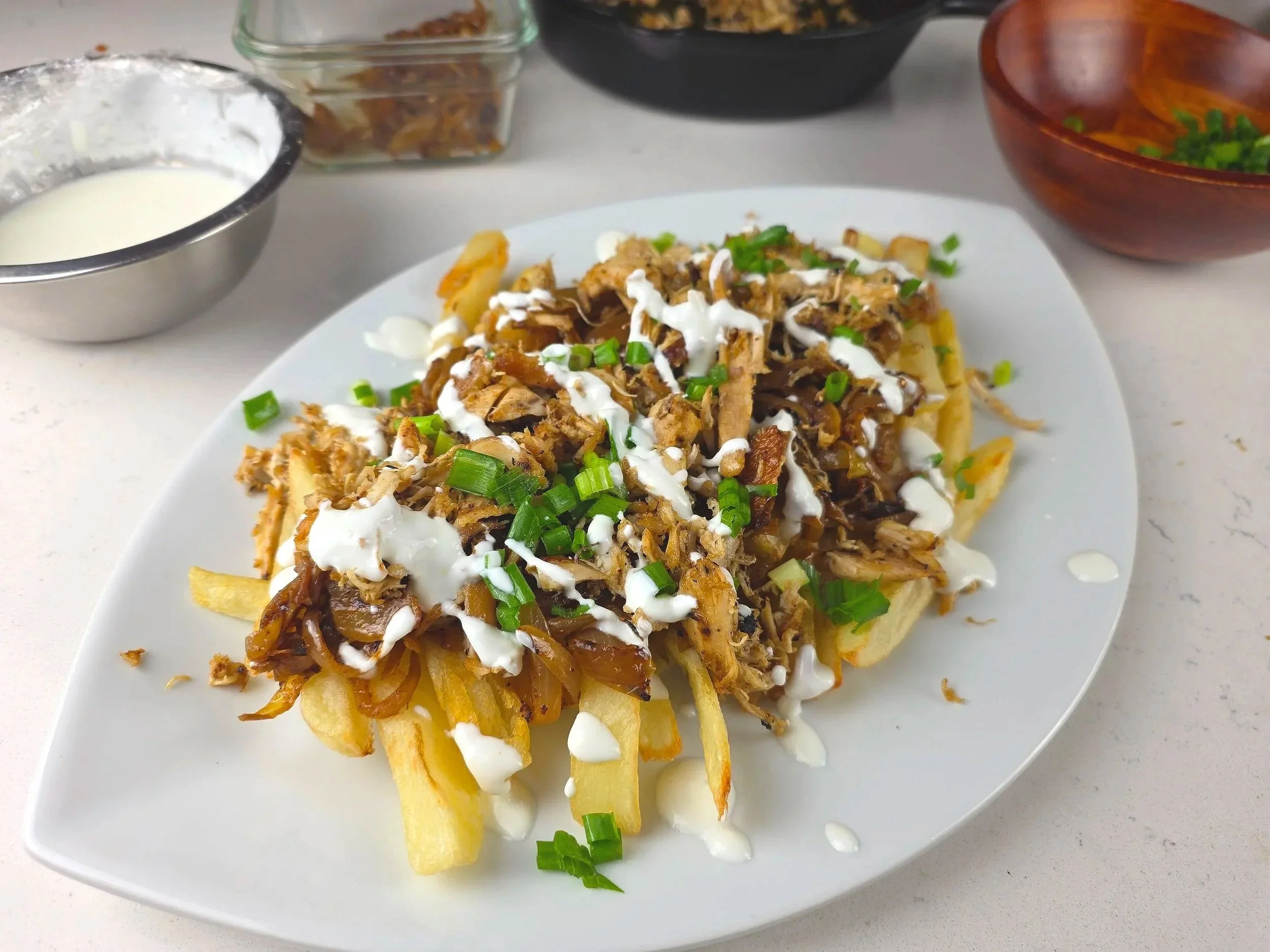
Inspired by Chicken Yassa, a Senegalese dish known for deeply caramelized onions, lemon, Dijon mustard, garlic and chile, this recipe uses rotisserie chicken to make the dish quick and approachable while still delivering those signature Yassa flavors. The chicken is tossed with deeply caramelized Yassa onions and their lemon-Dijon seasoning, then piled onto crispy homemade russet fries and finished with a cool garlic-yogurt sauce, crispy green onions and fresh scallions.
The Yassa onions are the heart of the dish. They're cooked slowly until soft, deeply golden and jammy, allowing the lemon, Dijon, garlic and chile to mellow into a rich, savory coating for the rotisserie chicken. Using prepared chicken means you can focus on building those bold flavors without the time required to cook chicken from scratch.
The fries are fried twice, first at a lower temperature to cook the potatoes through, then at a higher temperature to make them crisp and golden. That extra step gives them enough structure to hold up to the chicken, onions and sauce without becoming soggy.
These loaded fries are made for game day, watch parties, cookouts and casual entertaining. If you've never tried Chicken Yassa, this is a fun way to experience its signature flavors in a completely different format. If you're already a fan, you'll recognize the lemon, mustard, onion and chile combination in every bite
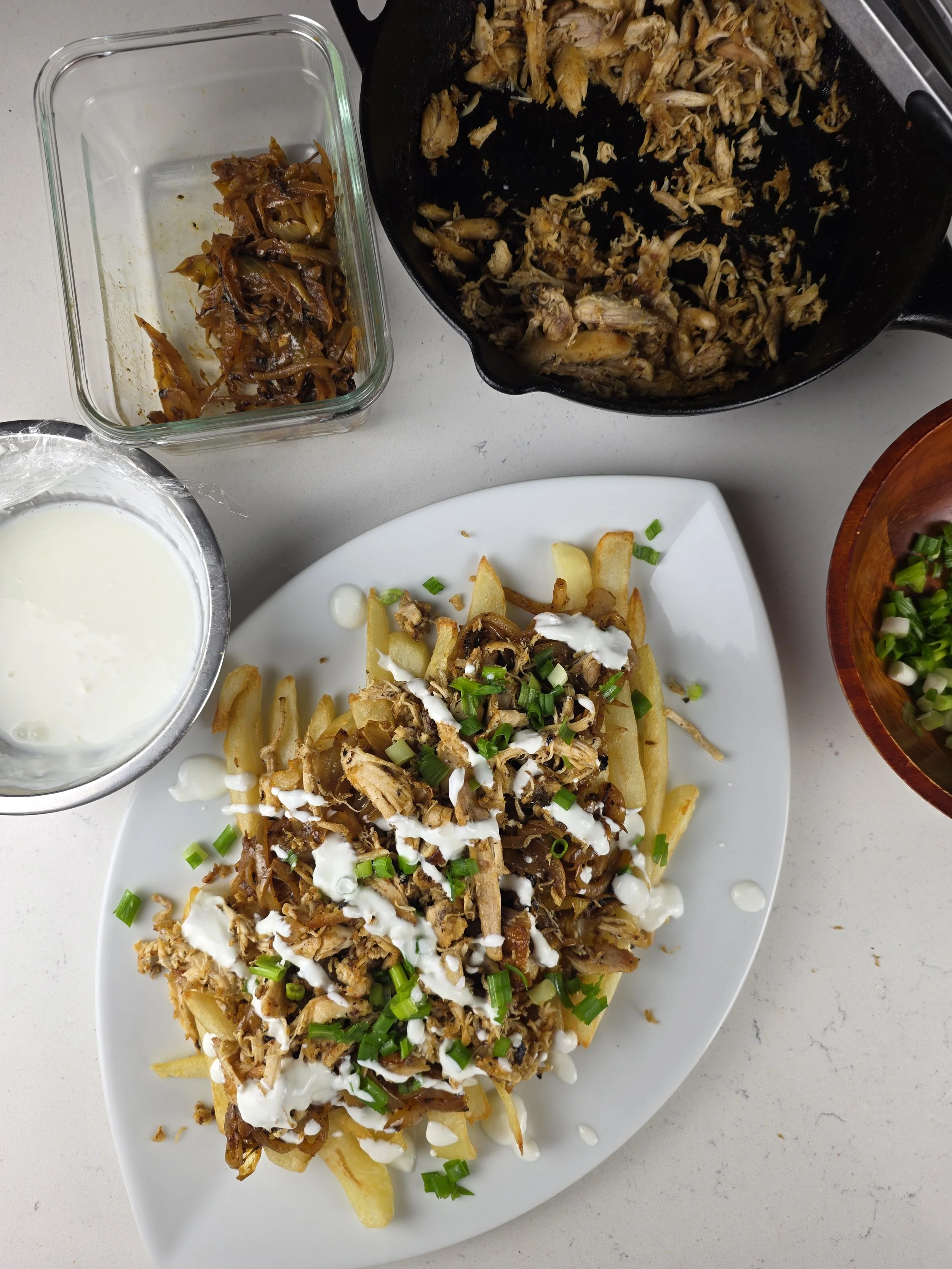

Chicken Yassa Loaded Fries
Crispy homemade fries topped with flavorful rotisserie chicken, jammy lemon-Dijon Yassa onions, garlic-yogurt sauce and crispy and fresh green onions. A quick, game-day-friendly take on Chicken Yassa without cooking the chicken from scratch.
Ingredients
- 3 cups shredded rotisserie chicken, using a combination of breast and dark meat when possible
- 2 large yellow onions
- 1 tablespoon chicken spice
- Juice of 1 lemon
- 1 tablespoon Dijon mustard
- 2 garlic cloves, minced
- ½ teaspoon cayenne
- ½ teaspoon black pepper
- 2 tablespoons water
- Pinch of salt
- 1 tablespoon neutral oil, for cooking
- 1 tablespoon butter
- 4 large russet potatoes
- Neutral high-heat oil, for frying
- Salt, to taste
- 5 ounces plain Greek yogurt
- 1 small garlic clove, finely grated or minced
- Lemon juice, to taste
- Garlic powder, to taste
- All-purpose seasoning, to taste
- Water, as needed to thin
- 4–5 green onions
- Olives, optional
- Fresh lemon wedges, for serving
Instructions
- Cut the potatoes into 1/4- to 1/3-inch fries. Place them in a large bowl of cold water and soak for 30 minutes.
- While the potatoes soak, prepare the chicken. Remove the skin and bones from the rotisserie chicken and pull the meat into irregular 1- to 1 1/2-inch pieces. You should have about 3 cups. Toss the chicken with 1 tablespoon chicken seasoning.
- Prepare the onions. Halve the onions from root to stem, peel them, and slice lengthwise into thin, approximately 1/8-inch strips.
- In a bowl, combine the juice of 1 lemon, Dijon mustard, minced garlic, cayenne, black pepper, 2 tablespoons water, and a pinch of salt. Add the sliced onions and toss well to coat. Let the onions marinate for 20 to 30 minutes.
- Drain the potatoes. If they are particularly starchy, rinse them once with cold water. Spread them in a single layer on clean kitchen towels and pat them completely dry. Let them air-dry while you prepare the chicken and onions.
- Heat 1 tablespoon neutral oil in a large skillet or cast-iron pan over medium heat. Add the marinated onions and cook for 20 to 25 minutes, stirring occasionally, until very soft, deeply golden and jammy. If the onions begin sticking or browning too quickly, add 1 to 2 tablespoons water at a time and continue cooking over medium-low heat. Remove from the heat and set aside.
- In a separate skillet, heat a small amount of neutral oil over medium-high heat. Add the seasoned rotisserie chicken and 1 tablespoon unsalted butter. Cook for about 5 minutes, tossing occasionally, until the chicken is heated through with lightly browned edges. Add a pinch of bouillon powder and toss to combine. If the chicken seems dry, add 1 to 2 tablespoons water. The chicken should be moist and well coated, not soupy. Remove from the heat.
- Make the garlic-yogurt sauce. Stir together the Greek yogurt and minced garlic. Add the lemon juice, garlic powder and all-purpose seasoning to taste. Add 1 to 2 tablespoons water as needed until the sauce is smooth and drizzleable. Refrigerate until ready to assemble.
- Heat 1 1/2 to 2 inches of neutral high-heat oil in a heavy skillet or Dutch oven to 325°F. Working in batches, fry the potatoes for 4 to 6 minutes, until cooked through but still pale. Transfer to a paper towel-lined plate or rack and allow the oil to return to 325°F between batches.
- Increase the oil temperature to 375°F. Fry the potatoes again in batches for 2 to 4 minutes, until deep golden and crisp. Drain and immediately season with salt.
- Prepare the green onions. Separate the white and light-green portions from the dark-green tops. Fry the white and light-green portions in a small amount of oil over medium-high heat until lightly browned and crisp. Drain well. Thinly slice the dark-green portions and keep them fresh for topping.
- Assemble just before serving. Arrange the hot fries on a serving platter, top with the browned rotisserie chicken and Yassa-style onions, then drizzle generously with the garlic-yogurt sauce. Finish with the crispy fried green onions and fresh scallions.
- Add olives and fresh lemon wedges, if desired. Serve immediately. For the best texture, do not assemble the fries too far in advance, as the chicken, onions and sauce will soften the fries.
Notes
- Don't skip the double fry. The first fry cooks the potatoes through; the second fry creates the crisp exterior needed to support the toppings.If the onions begin to burn before becoming tender, lower the heat and add water 1–2 tablespoons at a time.
- For the chicken, using both breast and dark meat gives the topping a better balance of texture and moisture.
- Keep the garlic-yogurt sauce relatively mild. Its purpose is to cool and balance the intensely flavored Yassa chicken and onions rather than compete with them.
- Assemble immediately before serving. The longer the fries sit underneath the toppings, the softer they will become.
- Olives are optional but work particularly well with the lemony Yassa flavor and are common in many versions of Chicken Yassa.
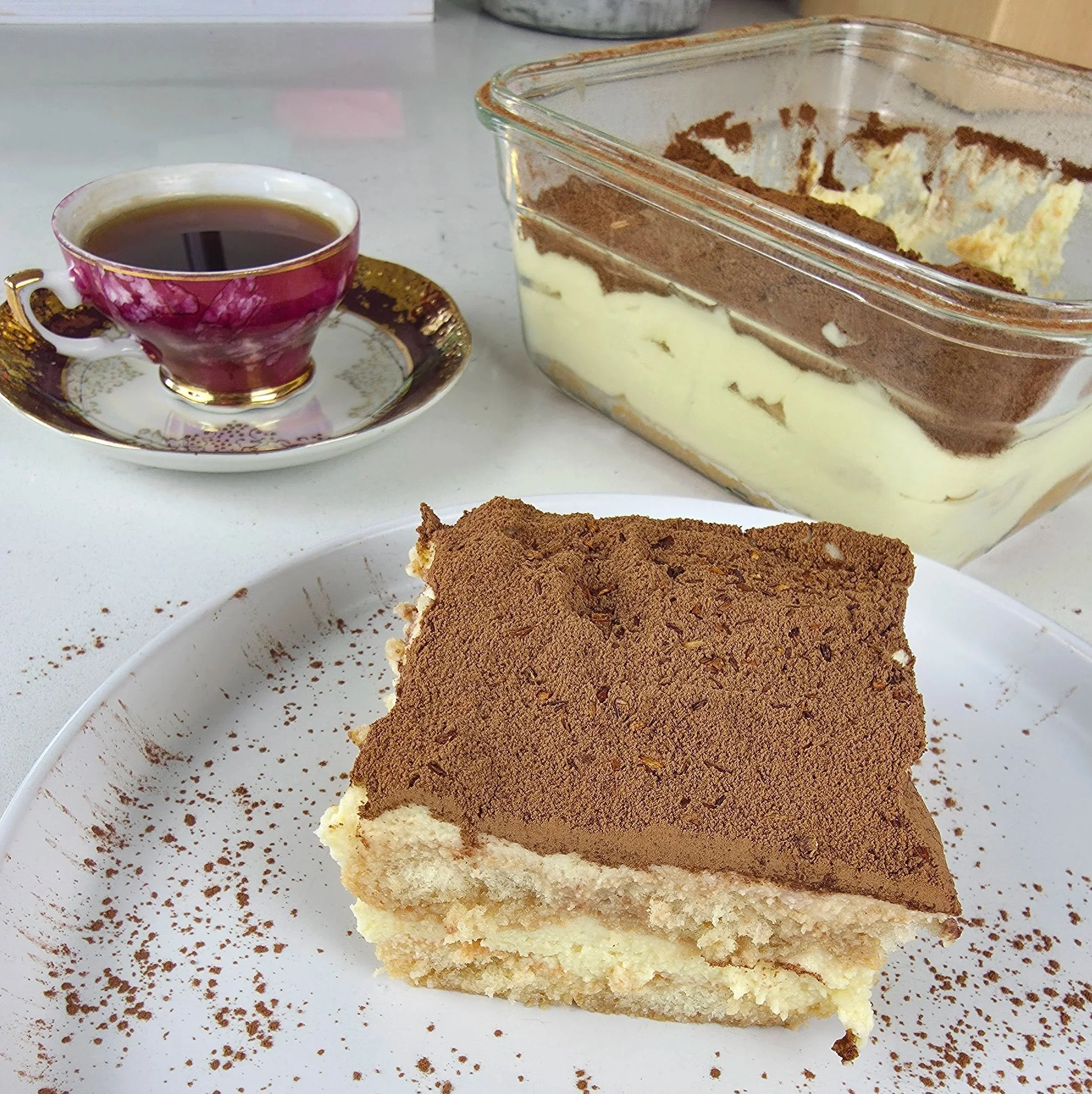
Rooibos Tiramisu
A Southern African-inspired take on Italian tiramisu, this Rooibos Tiramisu replaces the traditional coffee soak with strong rooibos tea, masala wine and vanilla for a creamy, aromatic dessert that's perfect for tea lovers.
Tiramisu is one of those desserts that doesn't really need an introduction. Creamy mascarpone, delicate ladyfingers, cocoa and that unmistakable coffee-soaked bite make it a classic for a reason. But what happens when you're a tea lover who wants to experience tiramisu without making coffee the star?
I first fell in love with making tiramisu during a cooking class in Italy, where I had the chance to make the classic version from scratch. There's something special about preparing a dish in the place where it originated—or at least, in the country that made it famous around the world. Working with mascarpone, egg yolks, sugar and those delicate Italian ladyfingers gave me a much better appreciation for why the dessert works so well. But when I started thinking about putting my own spin on it, I didn't want to simply swap one ingredient for another and call it a new recipe. I wanted the twist to actually make sense, and for me, that meant rooibos.
Rooibos is naturally caffeine-free, with a mellow, nutty, earthy sweetness and subtle notes that can lean toward vanilla, honey and even cocoa depending on the blend. It also happens to be one of those ingredients that immediately brings a South African connection to a dessert that is otherwise unmistakably Italian.
Instead of soaking the ladyfingers in coffee, they're dipped in a strong rooibos infusion, finished with a little marsala wine and vanilla. The result isn't supposed to taste like coffee tiramisu with tea substituted for the coffee. The goal is something different: a tiramisu where rooibos has its own identity.
I also wanted to keep the dessert approachable for people who simply aren't coffee drinkers. If you love tea, don't drink caffeine, or just want something unexpected for dessert, this version gives you the creamy, cocoa-dusted experience of tiramisu while taking it in a completely different direction.
The mascarpone cream remains rich and airy, while the rooibos brings warmth and depth. A small amount of espresso powder in the cocoa topping is there only to deepen the chocolate notes—not to turn the dessert back into a coffee tiramisu.
It's a little bit Italy, a little bit Southern Africa, and very much my kind of fusion.
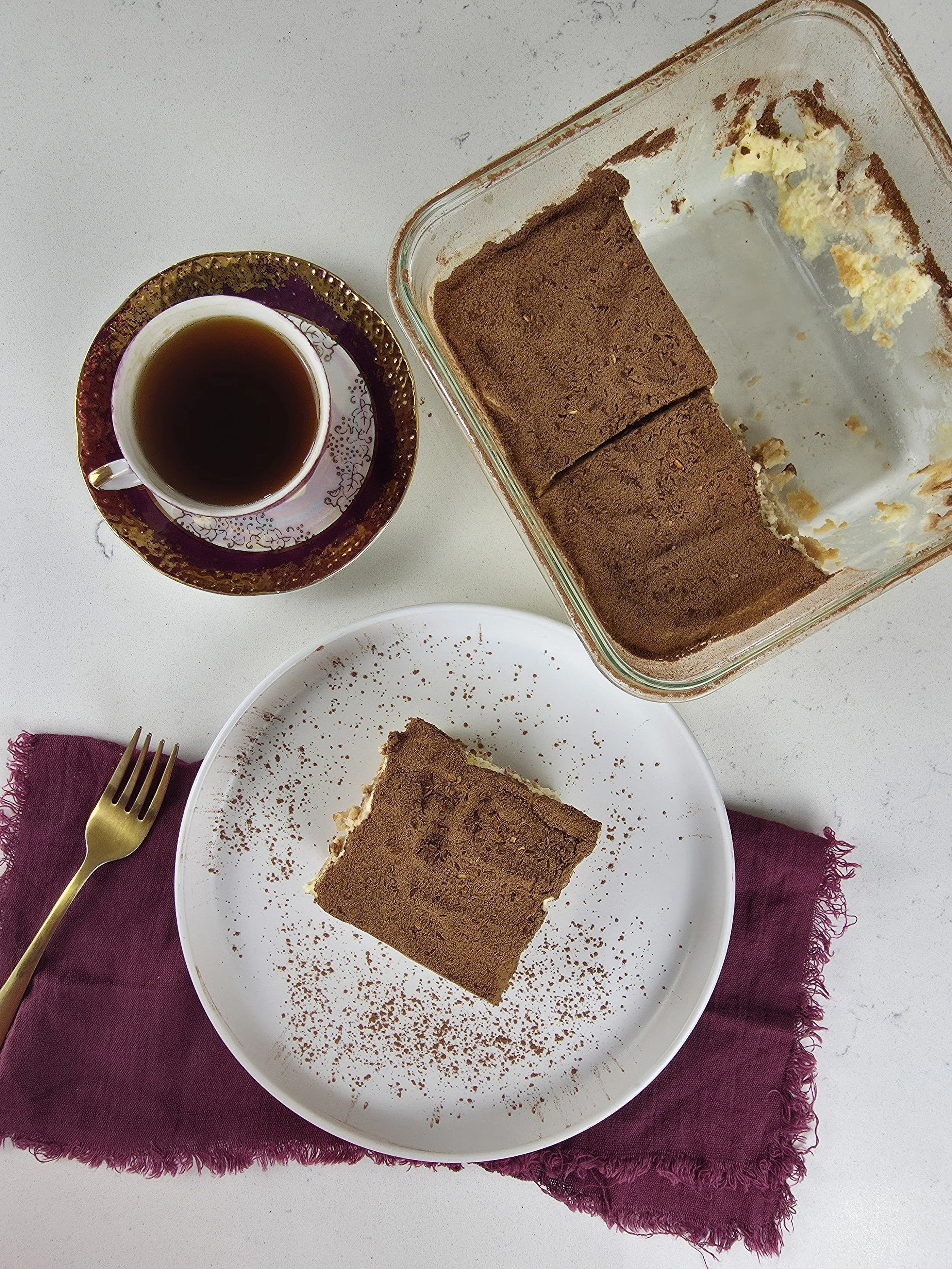
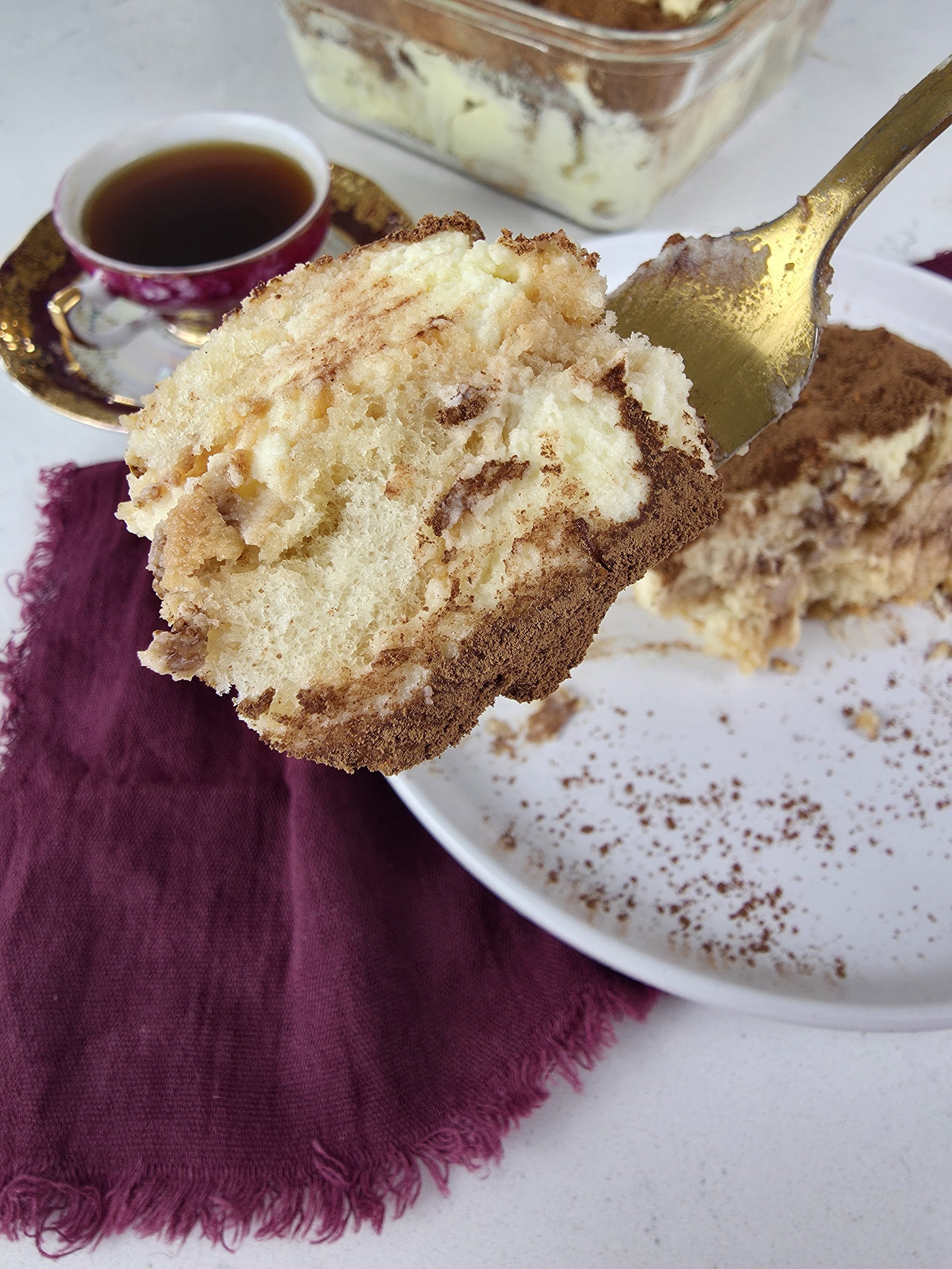

Rooibos Tiramisu
A Southern African-inspired twist on classic Italian tiramisu, made with bold rooibos tea, masala wine, mascarpone and a cocoa-espresso finish.
Ingredients
- 1 cup water
- 2 teaspoons loose-leaf rooibos
- 1 tablespoon granulated sugar
- 2 tablespoons masala wine
- ½ teaspoon vanilla extract
- 2 large egg yolks
- ¼ cup (50g) granulated sugar
- 1 tablespoon masala wine
- 8 ounces (225g) mascarpone, slightly softened
- ⅔ cup (160ml) heavy whipping cream, cold
- ½ teaspoon vanilla extract
- Pinch of salt
- 12–14 Savoiardi ladyfingers
- Topping
- 1 tablespoon unsweetened cocoa powder
- ¼ teaspoon espresso powder
- Optional: a tiny pinch of very finely crushed rooibos leaves for visual garnish
Instructions
- Bring 1 cup of water to a boil. Add the rooibos and steep for 8–12 minutes, or until very strong. If needed, add a little more water and additional loose-leaf rooibos to account for evaporation and maintain enough liquid for dipping the ladyfingers. Remove the tea bags or strain the loose tea once the rooibos is ready. You can prepare the remaining components while the tea steeps.
- While the tea is still hot, stir in the sugar until dissolved. Allow the tea to cool to warm or room temperature, then stir in the masala wine and vanilla. Set aside.
- In a heatproof bowl, whisk together the egg yolks, sugar, and 1 tablespoon of masala wine. Place the bowl over a saucepan of gently simmering water, making sure the bottom of the bowl does not touch the water. Whisk constantly until the mixture reaches 160°F. Remove from the heat and let cool for about 5 minutes.
- Transfer the cooked yolk mixture to a large bowl. Add the mascarpone, vanilla, and salt, and whisk until smooth.
- In a separate bowl, whip the cold heavy cream to medium-stiff peaks. Gently fold half of the whipped cream into the mascarpone mixture, then fold in the remaining cream just until combined. Do not overmix.
- Pour the rooibos soak into a shallow dish. Dip each ladyfinger very briefly, about 1 second per side, until moistened but not saturated.
- Arrange the dipped ladyfingers in a single layer across the bottom of a 6 × 6-inch dish, breaking them as needed to fit. Spread half of the mascarpone cream evenly over the ladyfingers. Add a second layer of dipped ladyfingers, followed by the remaining mascarpone cream. Smooth the top.
- Combine the cocoa powder and espresso powder, then sift the mixture evenly over the tiramisu. If desired, finish with a tiny pinch of finely crushed rooibos leaves for visual contrast.
- Cover and refrigerate for at least 4 hours, preferably overnight. Serve chilled.
Notes
- Strong rooibos matters. The tea should taste more concentrated than a normal cup because the mascarpone and ladyfingers will mellow it.
- Don't oversoak the ladyfingers. A very quick dip keeps the tiramisu structured rather than soggy.
- The espresso powder is subtle. It deepens the cocoa flavor without turning this into coffee tiramisu.
- Masala wine: The small amount adds warmth and spice without overpowering the rooibos.
- Egg safety: The yolk mixture is heated to 160°F before being incorporated into the cream.
Nutrition Facts
Calories
580Fat (grams)
37 gSat. Fat (grams)
22 gCarbs (grams)
56 gSugar (grams)
29 gProtein (grams)
9 gI am not a certified nutritionist and any nutritional information on dontmissmyplate.com should only be used as a general guideline.
Suya-Spiced Chicken Plantain Boats
I am obsessed with plantains. They are incredibly versatile, and having a few on hand is never a bad idea. Whether they're fried, baked, mashed, or stuffed, plantains can easily become the foundation of a quick meal or a show-stopping dish.
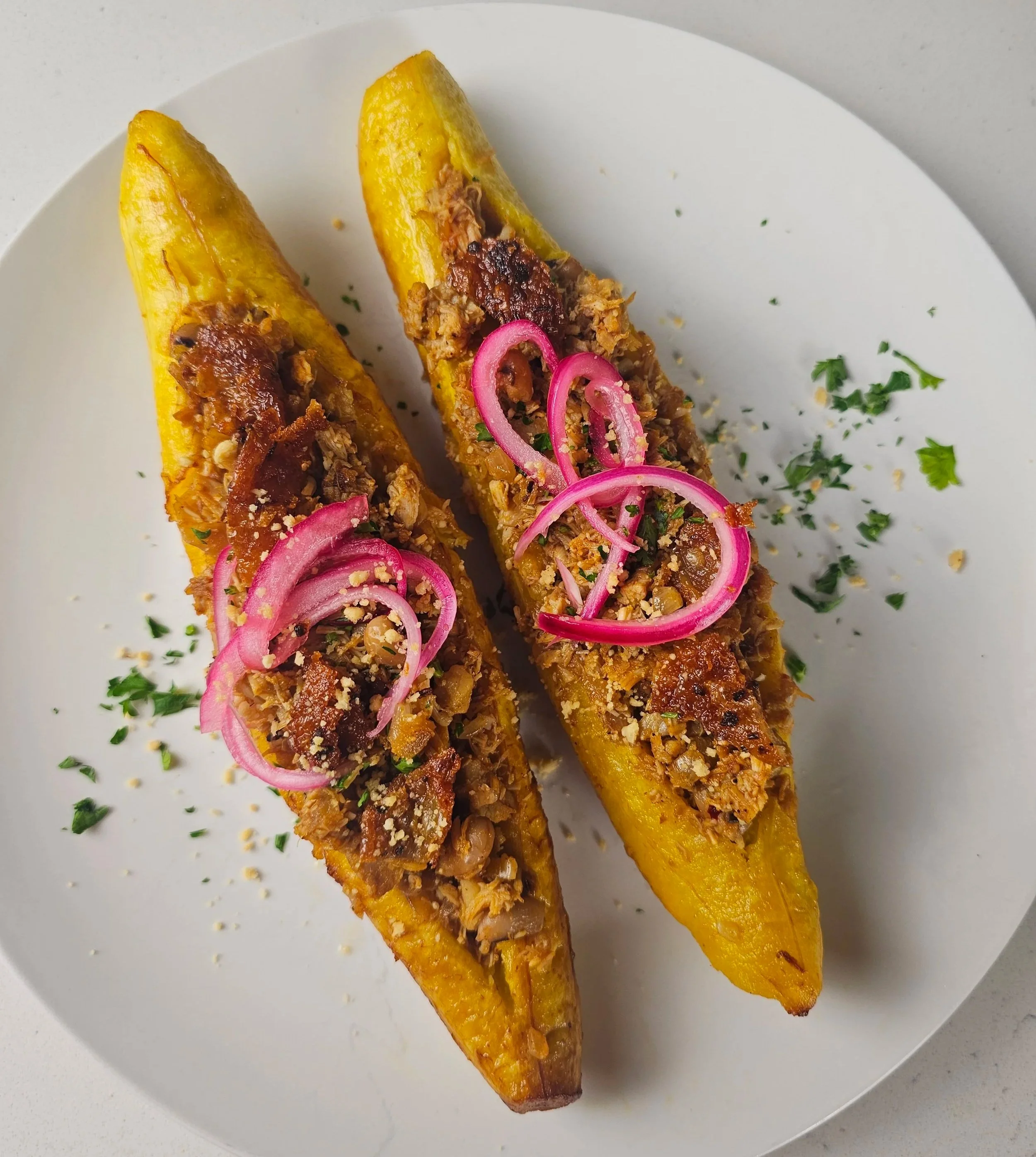
Plantain boats are one of those recipes that naturally invite creativity. A simple base of ripe plantains is transformed into something bold, layered, and deeply satisfying. In this version, leftover rotisserie chicken is reimagined into a 30-minute dish that draws inspiration from Caribbean plantain traditions and the peanut-forward, spice-driven flavors found across parts of Africa.
As a Zimbabwean, I grew up with dishes like huku nedovi, where peanuts play a central role in creating richness and depth. While this recipe is not a traditional Zimbabwean dish, the combination of peanuts and warming spices immediately feels familiar to me. That same appreciation for nutty, savory flavors is part of what drew me to suya (yaji) seasoning, a West African spice blend known for its smoky, bold character and use of ground peanuts.
Across the Caribbean and Latin America, plantains are a foundational ingredient used in both sweet and savory preparations. Their natural sweetness makes them ideal for balancing spice, acidity, and richness. Plantains are also enjoyed throughout many African countries, often fried, roasted, or served alongside stews and grilled meats, making them a natural bridge between the influences behind this dish.
The filling combines shredded rotisserie chicken with suya seasoning, tomato paste, Worcestershire sauce, and aromatics, then is lightly bound with peanut butter for texture and cohesion. Quick-pickled red onions provide brightness and acidity, while crispy chicken skin is repurposed as a crunchy topping that reinforces the roasted flavor of the bird. A final sprinkle of crushed peanuts echoes the nutty notes in the seasoning and ties the dish together.
Designed for speed, flexibility, and maximum flavor, these Suya-Spiced Chicken Stuffed Plantain Boats show how a handful of pantry ingredients and leftovers can be transformed into something vibrant, visually striking, and deeply satisfying in under 30 minutes.

Suya-Spiced. Chicken Plantain Boats
Sweet fried plantains stuffed with suya-spiced rotisserie chicken, crunchy peanuts, crispy chicken skin, and tangy quick-pickled red onions. This easy 30-minute recipe brings together bold flavors, contrasting textures, and a creative use for leftover chicken.
Ingredients
- 4 ripe yellow plantains with black spots (not overly ripe to hold structure)
- Peanut oil, for frying (shallow fry)
- Crispy chicken skin, from rotisserie chicken
- 2 cups shredded rotisserie chicken (mostly thigh/leg meat, some breast)
- 1 small yellow onion, finely diced
- 2 garlic cloves, minced
- 1 tbsp suya spice
- 1 tsp smoked paprika
- 2 tsp tomato paste
- ½ tsp chicken boullion paste
- 1 tbsp Worcestershire sauce
- 1-2 tbsp peanut butter
- 2–3 tbsp to ½ cup water (adjust if chicken is more or less dry)
- Salt and black pepper, to taste
- 1 tsp chili flakes, to taste (optional)
- 2 tbsp crushed roasted peanuts (optional garnish)
- Fresh parsley, chopped (optional garnish)
- Pickled red onions (store bought or homemade, optional garnish)
- ½ large red onion
- ½ cup vinegar
- ½ cup hot water
- ½ tsp salt
- 1 tsp sugar
- 1-2 bay leaves
- 1 tsp black peppercorns
- 1 tbsp grenadine
Instructions
- In a bowl or jar, combine the vinegar, hot water, sugar, salt, bay leaf, peppercorns, and grenadine. Add the sliced red onion and stir well. Set aside while you prepare the remaining ingredients.
- Place the chicken skin in a cold skillet and set over medium heat. Cook for 5–8 minutes, turning occasionally, until crisp and golden brown. Transfer to a plate and set aside. You can chop finely or into shards.
- Heat at least 1 inch of peanut oil in a skillet over medium to medium-low heat. Fry the peeled plantains for 2–3 minutes, turning occasionally, until golden and softened. Remove from the oil and let rest for 3–5 minutes.
- Using a sharp knife, cut a lengthwise slit down the center of each plantain, being careful not to cut all the way through.
- Using the back of a spoon, gently press and widen the opening to create a deep cavity for the filling. If necessary, trim a thin slice from the bottom so the plantains sit flat.
- Heat a skillet over medium heat. Add the diced onion and cook for about 2 minutes, until softened.
- Add the garlic and cook for 30 seconds more.
- Stir in the tomato paste and boullion paste. Cook for 1–2 minutes, until the mixture darkens slightly and becomes fragrant.
- Add the shredded chicken, suya spice, paprika, chili flakes, salt, and black pepper. Stir to combine.
- Add the peanut butter and 2–3 tablespoons, or up to half a cup of water. Mix until evenly coated. Cook for 2–3 minutes, until thick, moist, and slightly sticky.
- Add the beans and Worcestershire sauce, and finish for another 1–2 minutes.
- Spoon the chicken filling generously into each plantain boat, in portions.
- Top with the pickled red onions, crispy chicken skin, crushed roasted peanuts, and chopped parsley.
- Serve warm.
Notes
- If filling looks dry: add 1 tbsp water at a time until glossy
- Plantains must be ripe (yellow with black spots) for softness
- Don’t overfill peanut butter, it should bind, not dominate
- Worcestershire replaces soy sauce in this version for deeper, rounder umami
- The final dish should look layered, not saucy
- Texture contrast is essential: crispy skin + soft plantain + acidic onions
I am not a certified nutritionist and any nutritional information on dontmissmyplate.com should only be used as a general guideline.
Biltong Carbonara
Carbonara is one of the most iconic Roman pasta dishes in the world, traditionally built around cured pork, pecorino cheese, eggs, black pepper, and pasta water to create a silky emulsion without cream. In this version, I wanted to reinterpret that structure through a Southern African lens using one of the region’s most beloved ingredients: biltong.
Biltong is a cured and air-dried beef commonly enjoyed across Zimbabwe, South Africa, Botswana, and Namibia. While many people compare it to jerky, the flavor and texture are completely different. Biltong is richer, more tender, and deeply savory, with concentrated beef flavor from the curing and drying process. It is not just a snack where I come from, it is part of the culture.
For this dish, I wanted to respect the foundation of a traditional carbonara while introducing the bold identity of biltong in a way that still feels intentional and balanced. Instead of replacing the classic smoky pork notes entirely, I use rendered bacon fat to preserve that familiar carbonara backbone while allowing the cured beef flavor of the biltong to take center stage.
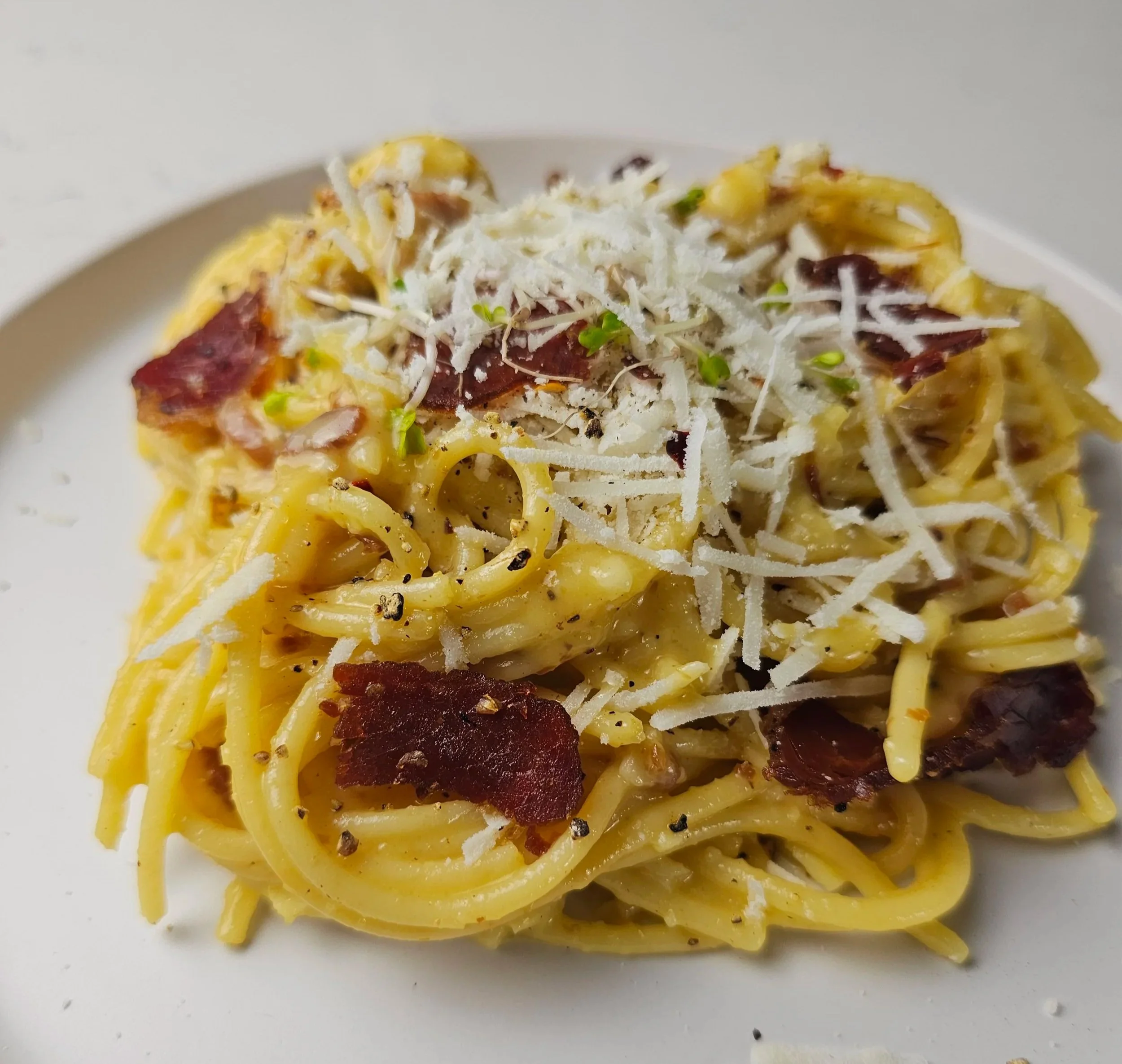
The result is a fusion dish that feels both comforting and personal. Silky pasta coated in a glossy pecorino and egg sauce, layered with black pepper, smoky bacon fat, and the deep umami of biltong.
This recipe reflects the kind of cooking I love most, honoring classic techniques while telling my own story through flavor.

Biltong Carbonara
A Southern African-inspired twist on classic Roman carbonara made with biltong, pecorino, eggs, and smoky bacon fat for a rich, savory pasta with bold cured beef flavor.
Ingredients
- 8 oz (225g) dry spaghetti noodles
- 3 strips thick bacon (for rendered fat)
- 1 cup (black pepper) biltong, divided into two portions (½ cup finely chopped and ½ cup sliced for garnish)
- 2 whole eggs
- 1 egg yelp
- 1 1/4 cup grated pecorino cheese
- 1½ teaspoon freshly cracked black pepper
- 1 large garlic clove, smashed
- 1–1½ cups reserved pasta water
- Chilli flakes (optional)
Instructions
- In a large mixing bowl, combine the egg, yolk, pecorino, ½ teaspoon of the black pepper, and 1/2 the biltong, finely chopped. Mix thoroughly with a fork until fully combined then set aside.
- Bring a large pot of salted water to a boil. Cook the spaghetti noodles until 1 minute before al dente according to package instructions.
- Reserve 1–1½ cups pasta water before draining.
- Place bacon strips into a cold pan. Turn heat to medium-low and cook until crispy and the fat has rendered, about 6–8 minutes. Remove bacon (use for another reicepe) and set the oil aside. Keep rendered fat in the pan.
- Lower heat to low-medium then add smashed garlic clove and a small pinch of black pepper to the bacon fat. Cook for 20–30 seconds until fragrant, then remove garlic.
- Add drained pasta into the pan and toss in the bacon fat, follwoed by add a small splash of reserved pasta water and toss again.
- Transfer the pasta to the mixing bowl with the egg mixture.
- Wait about 10 seconds so the pasta is hot but not scorching.
- Toss aggressively until the sauce begins coating the pasta.
- Add reserved warm pasta water gradually, 1 tablespoon at a time, until the sauce becomes glossy and silky. Be patirnet, it's can take a few mintue!
- Twirl pasta onto serving plates and top servings with sliced biltong, extra pecorino, freshly cracked black pepper and chilli flakes.
- Serve immediately.
Nutrition Facts
Calories
640Fat (grams)
34 gSat. Fat (grams)
14 gCarbs (grams)
38 gFiber (grams)
2 gProtein (grams)
32 gI am not a certified nutritionist and any nutritional information on dontmissmyplate.com should only be used as a general guideline.
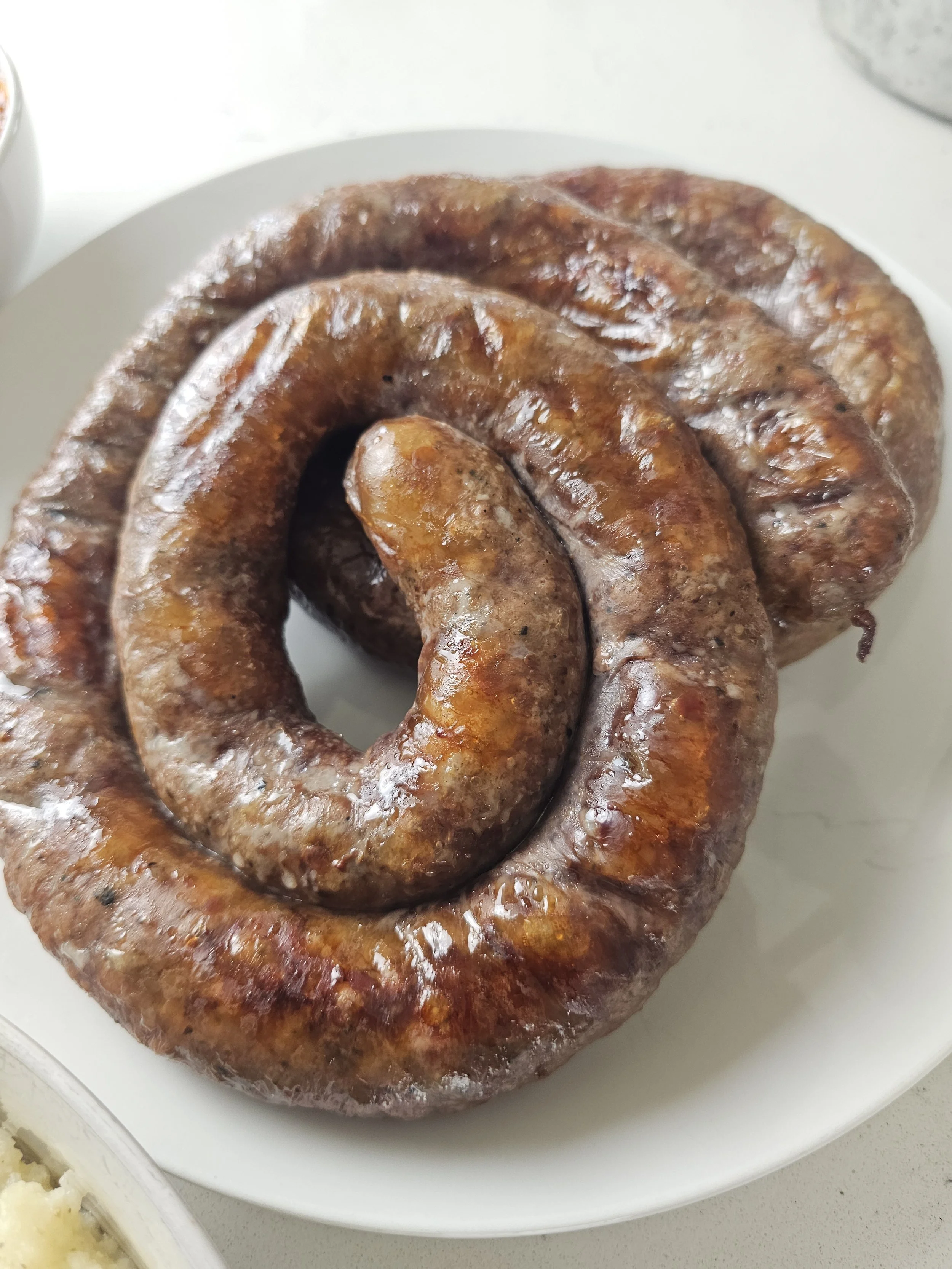
Braai-Style Homemade Boerewors Sausage with Cherry Plum
This is Part 3 of my braai-inspired series, and the final plate brings everything full circle with one of the most iconic elements of Southern African food culture: boerewors.
After exploring peri-peri chicken in Part 1 and BBQ- and curry-spiced lamb in Part 2, this final installment shifts focus to the centerpiece of many braai gatherings: sausage. In many Southern African homes, boerewors is not just another protein on the grill; it is often the anchor around which everything else is built. From the fire itself to the sides and conversations shared around the table, it holds a central place in the braai experience.
Traditional boerewors is typically made with a higher fat content (often around a 70/30 lean-to-fat ratio), which is key to its signature juiciness and flavour when grilled over open heat. That balance of fat is what gives it its distinctive texture and keeps it from drying out during the braai process.
For this final plate, I also followed through on the community vote, which leaned heavily toward sausage over fish. That result raised an interesting reflection on how different proteins fit into braai culture. While fish certainly plays an important role in some coastal traditions and regions, sausage remains one of the most recognizable and widely enjoyed staples of everyday braai cooking.
Rather than overcomplicating the process, I kept this recipe grounded and accessible. The sausage is made using seasoned ground meat, which can easily be prepared at home and stuffed into casings for full control over flavour and texture. It also serves as a practical introduction for anyone interested in trying homemade boerewors without needing specialized cuts or advanced butchery skills. I used a sausage-stuffing attachment for a KitchenAid mixer, though standalone sausage stuffers work just as well.
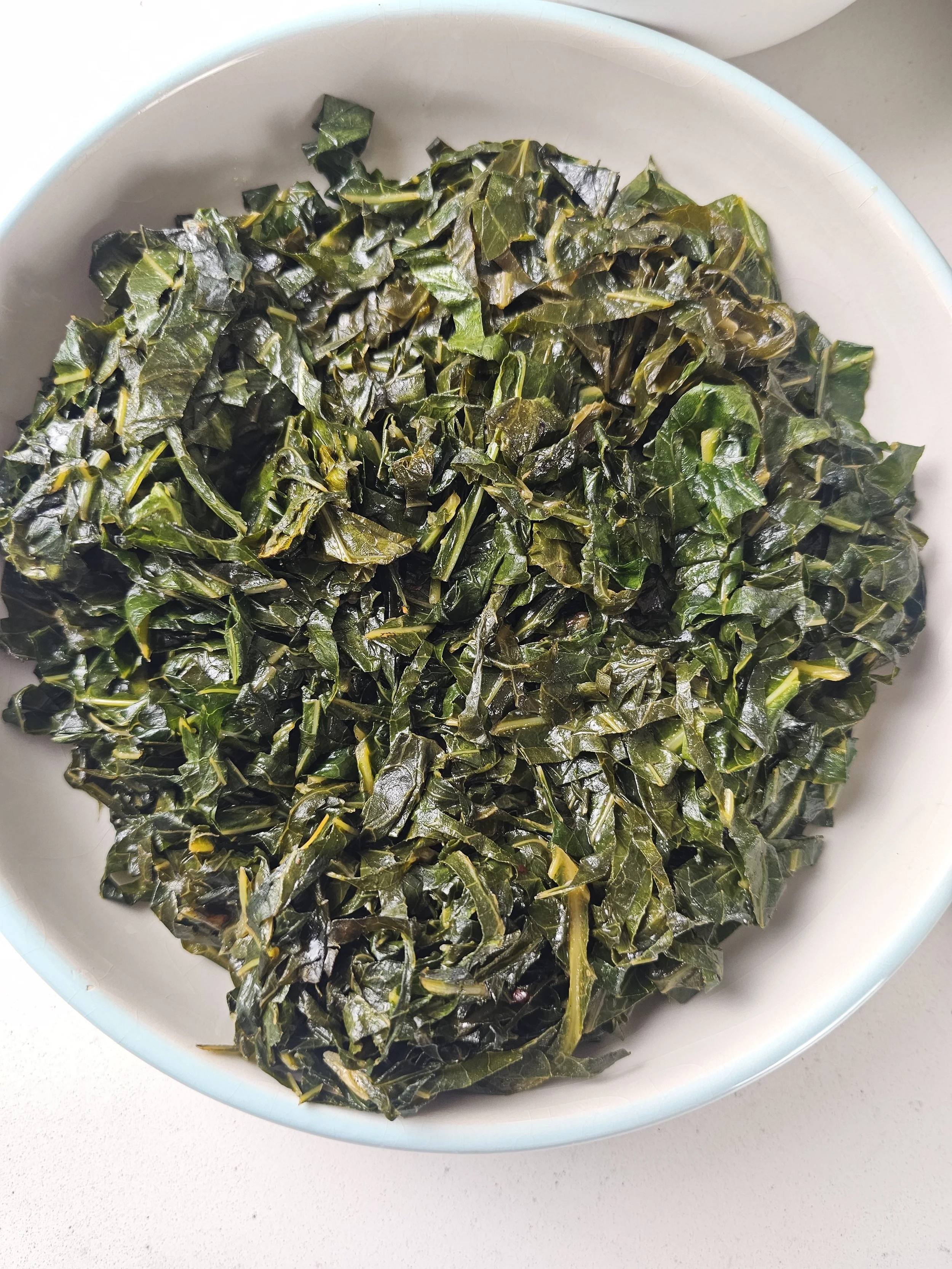
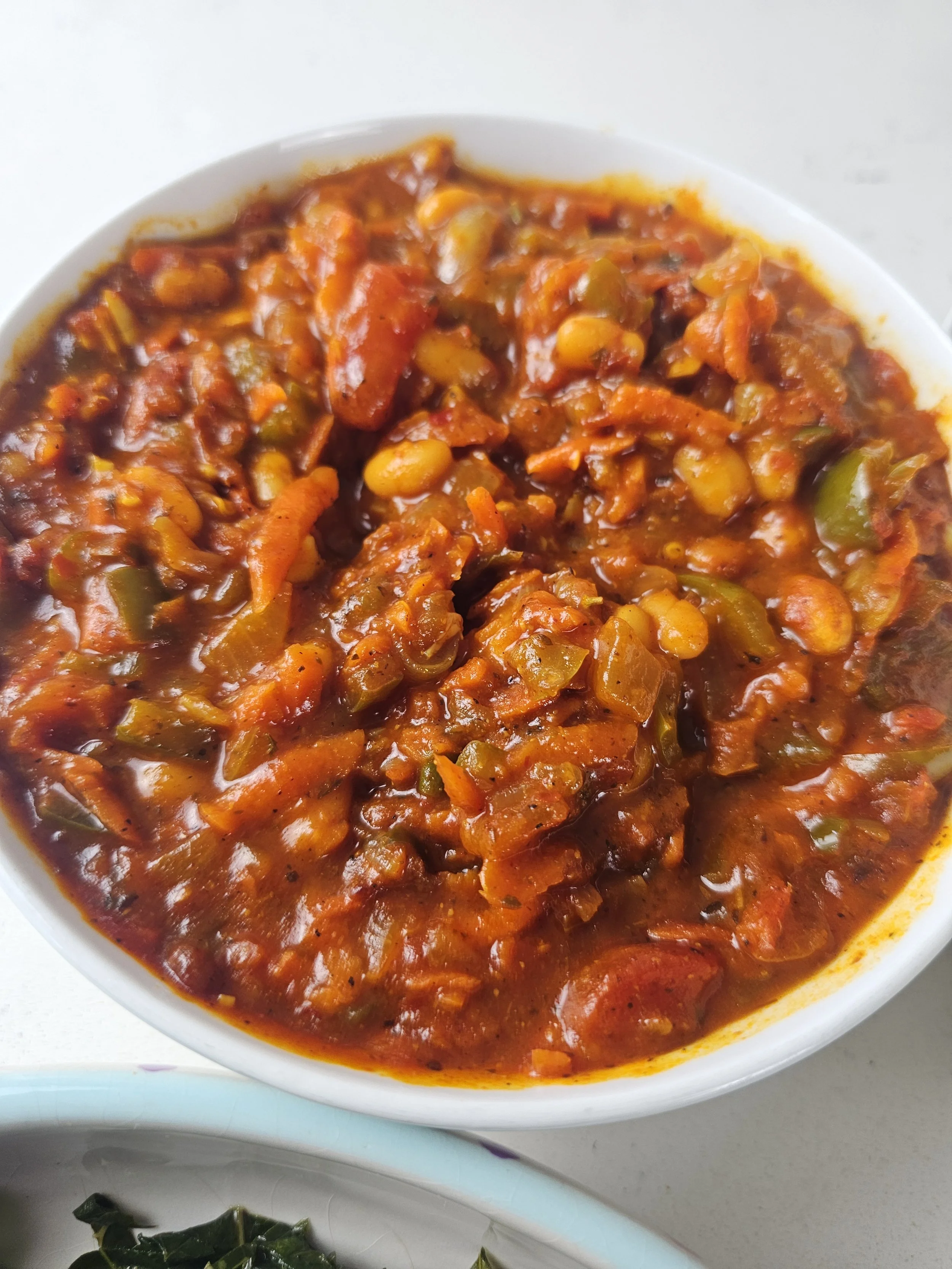
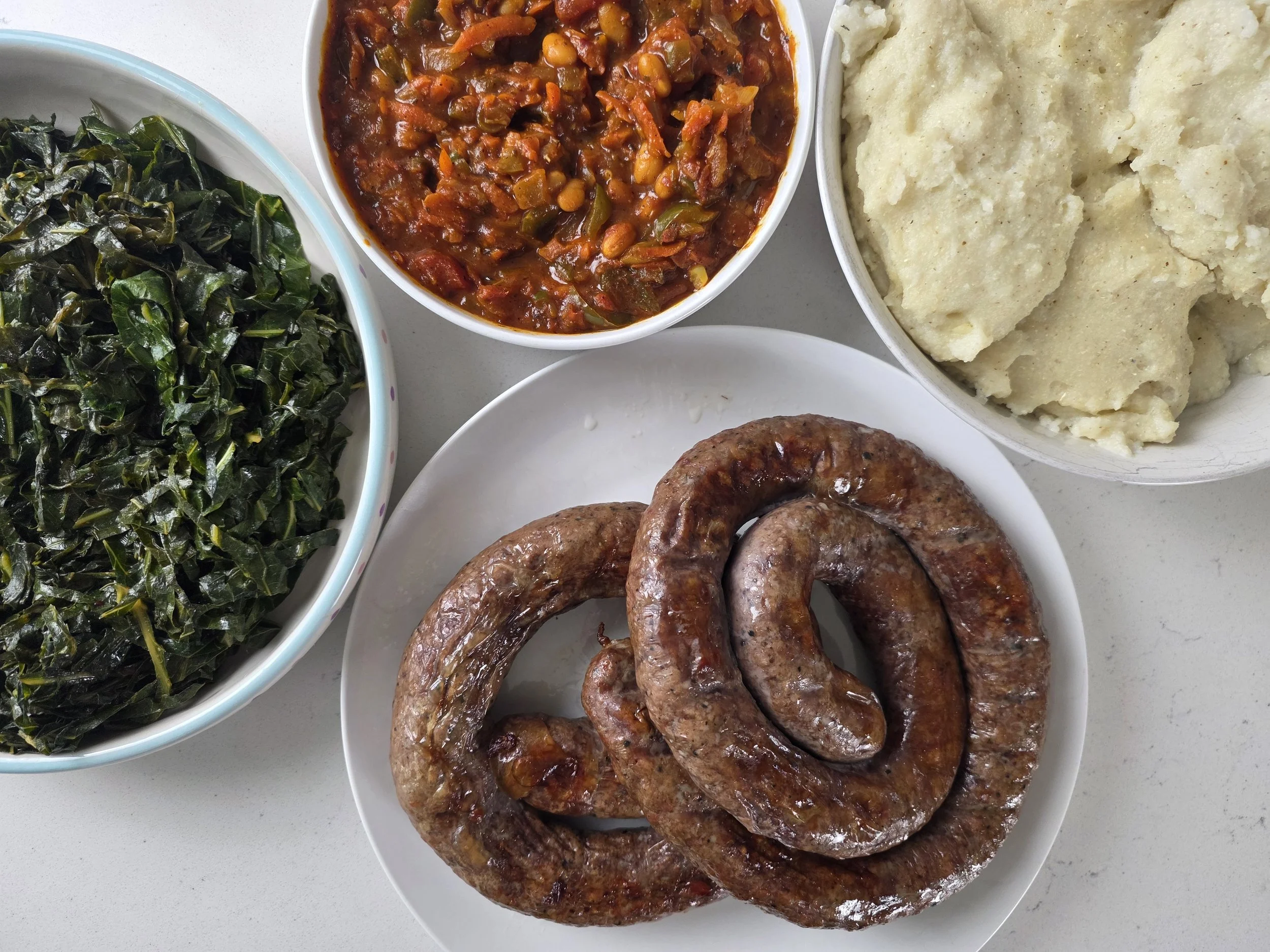
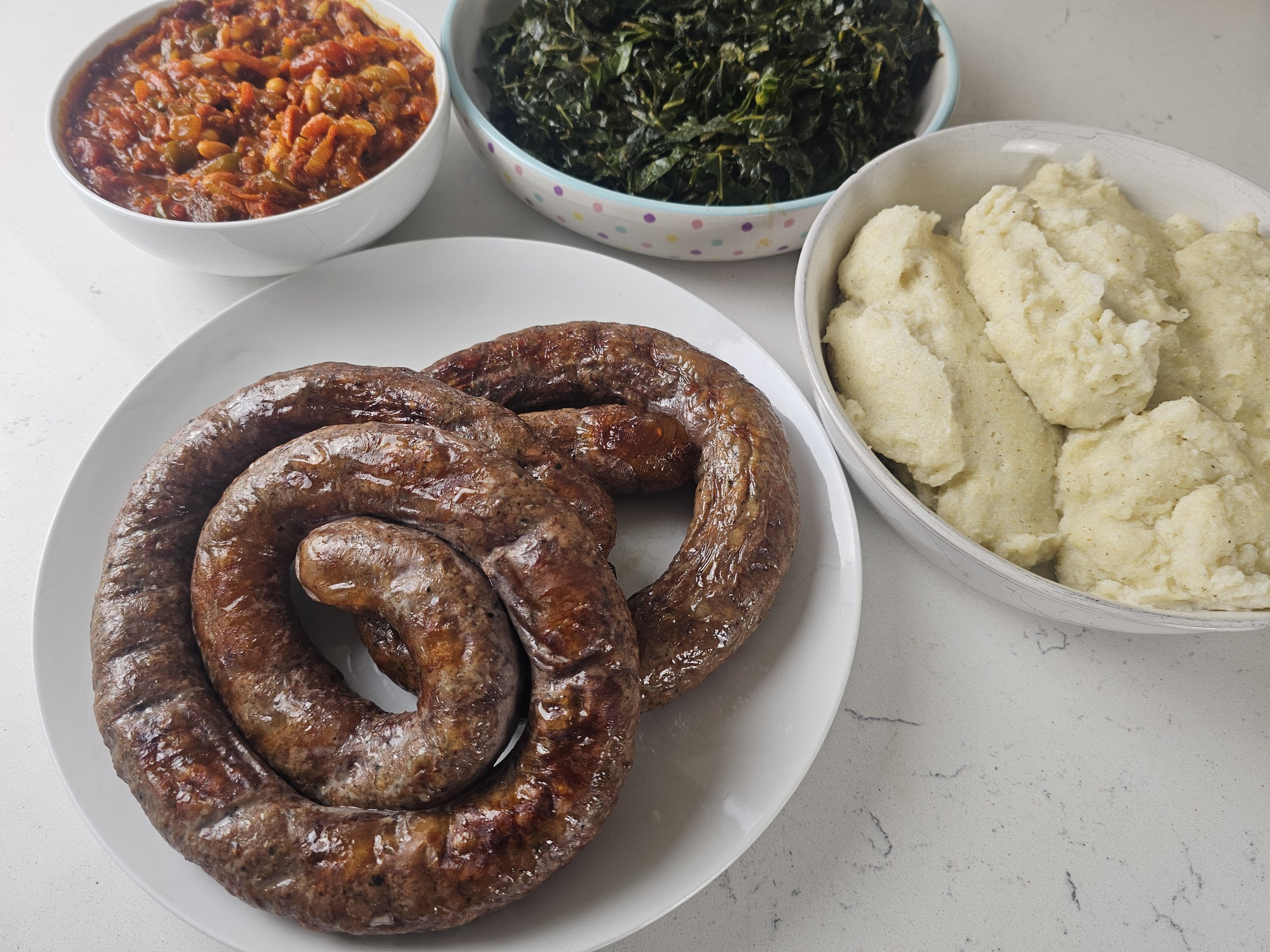
The plate is completed with classic sides: pap/sadza, chakalaka, and collard greens. These are not simply additions to the meal; they create balance. Pap/sadza provides the foundation, chakalaka brings heat and spice, and the greens add freshness and contrast. Together, they complete the structure of a proper braai plate.
To close the series, I paired the meal with a cherry plum drink, another choice inspired by the community vote. Throughout this series, drinks have played a subtle but important role in reflecting how braai culture extends beyond food alone. The drink adds brightness and balance, complementing the plate rather than competing with it.
This final recipe is less about complexity and more about completeness: a full braai experience that brings together fire, food, sides, and shared culture on one plate.

Braai-Style Boerewors Sausage with Pap, Chakalaka, and Collard Greens
A traditional boerewors-style sausage made from seasoned ground meat, stuffed and grilled for a classic Southern African braai plate. Served with soft pap, rich chakalaka (vegetable relish), and collard greens, and paired with a refreshing cherry plum drink.
Ingredients
- 2.4 lb ground beef (not too lean)
- 1 lb ground pork
- 2 tsp salt
- 1 tsp whole black peppercorns
- 2 tbsp whole coriander seeds
- 1/2 tsp whole allspice berries
- 1 tsp smoked paprika
- 1 tsp garlic powder
- 1/8 tsp ground cloves
- 1/8 tsp ground nutmeg
- 1 tbsp red wine vinegar
- 1 packet sausage casings (standard pack; amount used will vary depending on stuffing size for 3.4 lb meat)
- 2 cups maize meal
- 3 cups hot water (add gradually)
- 1 to 1½ cups cold water
- 1 tsp salt
- 1 tbsp butter
- 1 onion, chopped
- 2–3 carrots, grated
- 1 chilli pepper, minced (optional)
- 2–3 garlic cloves, minced
- 1 inch ginger, grated (optional)
- 1/2 cup roasted tomatoes, diced
- 1/2 green bell pepper, chopped
- 1/2 cup baked beans
- 1 tbsp curry powder
- 1 tsp coriander spice
- 1 tsp smoked paprika
- 1 tbsp tomato paste
- 2 tbsp cooking oil
- 1 cup water
- 2 tbsp Worcestershire sauce
- Salt and pepper to taste
- 4–5 cups collard greens
- 2 tbsp oil or butter
- 1 tbsp garlic powder
- Salt to taste
- Splash of water or stock
- Splash of vinegar
Instructions
- Toast coriander seeds, peppercorns, and allspice berries until fragrant, then crush.
- Mix spices with ground beef, pork, salt, paprika, garlic powder, cloves, nutmeg, and vinegar until just combined.
- Let the mixture rest for 20–30 minutes before stuffing.
- Stuff into casings, then loosely cover and refrigerate for 1–12 hours (overnight recommended).
- Before cooking, remove from fridge for 10–15 minutes.
- Grill over medium heat or bake at 325°F (160°C) for about 30 minutes, turning halfway, until browned and cooked through. Do not pierce sausages while cooking.
- Mix maize meal with cold water to form a smooth paste.
- Gradually add hot water while stirring to avoid lumps.
- Cook on low heat for about 15 minutes, stirring occasionally.
- Add more maize meal if needed to adjust thickness.
- Beat with a wooden spoon until smooth, then cover and let rest.
- Heat oil in a pan.
- Sauté onion, carrot, green pepper, chilli, garlic, and ginger until soft.
- Add curry powder, coriander, and smoked paprika and cook briefly.
- Add roasted tomatoes, tomato paste, baked beans, and water.
- Simmer 10–15 minutes until thick.
- Stir in Worcestershire sauce at the end and season.
- Sauté greens in oil or butter until wilted.
- Add a splash of water or stock, cover, and simmer until tender.
- Finish with salt and vinegar
Notes
- Always wash sausage casings properly according to packet instructions before use.
- Resting the sausage mixture before stuffing improves texture and handling.
- Do not cook sausages on high heat; low to medium heat prevents splitting.
- Pap texture can be adjusted by adding more maize meal or water depending on preference.
- Stuffing sausages takes practice; small tears or uneven lengths are normal for first attempts.
Nutrition Facts
Calories
650Fat (grams)
40 gCarbs (grams)
55 gProtein (grams)
30 gI am not a certified nutritionist and any nutritional information on dontmissmyplate.com should only be used as a general guideline.